RALT F302
|
|
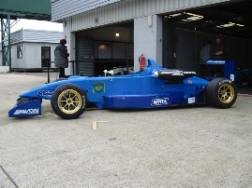
Ralt Engineering Ltd designed the 2002-2004 car based on all our
experience with the 1999-2001 car which won the 2000 US Formula 3 Championship
against the contemporary Dallara, being the only Ralt in the series.
From the outset, our intention was to create a car that is easy
to drive and set-up with emphasis on high-speed corner stability. To achieve
this, we introduced a number of innovative design features, some of which would
be well known to other manufacturers, such as weight distribution, suspension
geometry and car dimensions and some others that have been developed by Ralt
that would be less common knowledge.
|
|
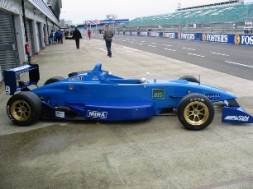
Another extremely important aspect of the design of a Formula 3
car is the aerodynamics. In contrast to current Formula One design strategy,
which focuses on maximum downforce, a Formula 3 car must be designed for the
best possible aerodynamic efficiency. In order to achieve our aerodynamic
targets we developed an effective strategy for our wind-tunnel program. The
wind-tunnel we used is a 40 percent scale moving ground facility. During the
work on our 1999-2001 Formula 3 car we had undertaken verification work on the
wind-tunnel data that showed its exceptional accuracy. Our early season testing
led us to believe that we have overtaken the current Dallara in this area.
|
|
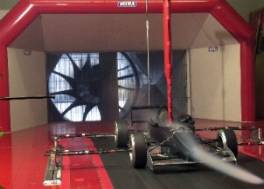
Wind
tunnel testing
Our
purpose designed gearbox played a large part in achieving the weight
distribution and aerodynamic targets we wanted. This was a very innovative step
since no other Formula 3 car manufacturer has produced an in-house gearbox for
20 years. The design of the gearbox has been undertaken here, at Ralt, and it
features a lightweight, super stiff, ultra small casing fitted with purpose
designed 10mm wide gears. A small, light weight limited slip differential unit
has been incorporated with 130mm diameter crown wheel, again specifically
designed for this application. Driveshafts are horizontal so there is no power
loss through the normally acute angled tripod joints associated with a normal
F3 installation. The overall length of the gearbox is some 200mm shorter than a
conventional Hewland Dallara unit. This in turn has put the weight further forward
towards the centre of the car for improved weight distribution and handling.
All hubs, dog rings and selectors are on the primary shaft, keeping the weight
low down. Fifth and sixth gears are overdriven so that a wide range of ratios
are available for the perfect top speed - engine rpm match. The gear change is
sequential and an oil pump is fitted as standard. The more compact gearbox has enabled us to create a very
efficient diffuser, significantly improving the under car air flow.
|
|
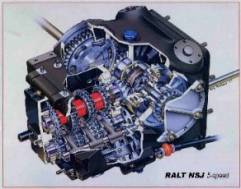
NSJ Gearbox
(Previous 5-speed variant pictured)